Anti-GluA1/GluR1 Glutamate Receptor Antibody (N355/1)
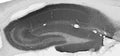
Our mouse GluA1/GluR1 glutamate receptor monoclonal antibody from NeuroMab is produced in-house from clone N355/1. It detects human, mouse, and rat GluA1/GluR1 glutamate receptor and is purified by Protein A chromatography. Works in WB, IHC, ICC, ELISA.
Human, Mouse, Rat
ELISA, ICC, IHC, WB
Mouse
SKU: 75-327
Ships: 1-2 business days
Product Details
GluA1/GluR1 glutamate receptor
Glutamate receptor 1 or GluA1/GluR1 glutamate receptor is a member of the glutamate-gated ion channel family. GluR1 funcitons as an excitatory neurotransmitter at many synapses in the central nervous system and is widely expressed in brain. Mutations in the GluR1 gene are associated with cerebral cortical dysplasia, Status Epilepticus, and depression.
Purified by Protein A chromatography
1 mg/mL
Monoclonal
N355/1
IgG1
ELISA, ICC, IHC, WB
Mouse
Gria1 Glur1
100 kDa
Fusion protein amino acids 1-389 (extracellular N-terminus) of rat GluA1/GluR1 (accession number P19490) produced recombinantly in E. Coli.
Rat
Human, Mouse, Rat
AB_2315840
Aliquot and store at ≤ -20°C for long term storage. For short term storage, store at 2-8°C. For maximum recovery of product, centrifuge the vial prior to removing the cap.
Liquid
Produced by in vitro bioreactor culture of hybridoma line followed by Protein A affinity chromatography. Purified mAbs are >90% specific antibody.
10 mM Tris, 50 mM Sodium Chloride, 0.065% Sodium Azide pH 7.125
WB: 1:1000
IHC: 1:250
ICC: 1:250
IHC: 1:250
ICC: 1:250
Unconjugated
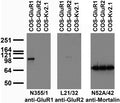
Does not cross-react with GluR2
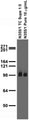
Each new lot of antibody is quality control tested by western blot on rat whole brain lysate and confirmed to stain the expected molecular weight band.
These antibodies are to be used as research laboratory reagents and are not for use as diagnostic or therapeutic reagents in humans.
United States
24 months from date of receipt
GLUR 1; Glutamate receptor 1; GLUR A; GluR-1; AMPA 1; AMPA-selective glutamate receptor 1; AMPA selective glutamate receptor 1; GluR-A; AMPA-selective glutamate receptor 1; GluR-K1; GluA1; Glutamate receptor ionotropic; GLUH1; GluA1; GluR K1; GluR-1; GluR-A; GluR-K1; GLUR1; GLURA; GluRK1; Glutamate receptor 1; Glutamate receptor ionotropic AMPA 1; Glutamate receptor ionotropic; Glutamate receptor; ionotropic; Gria1; GRIA1_HUMAN; HBGR1; MGC133252; OTTHUMP00000160643; OTTHUMP00000165781; THUMP00000224241; OTTHUMP00000224242; OTTHUMP00000224243; AMPA 1
P19490
UniProt Summary: Ionotropic glutamate receptor that functions as a ligand-gated cation channel, gated by L-glutamate and glutamatergic agonists such as alpha-amino-3-hydroxy-5-methyl-4-isoxazolepropionic acid (AMPA), quisqualic acid, and kainic acid. L-glutamate acts as an excitatory neurotransmitter at many synapses in the central nervous system. Binding of the excitatory neurotransmitter L-glutamate induces a conformation change, leading to the opening of the cation channel, and thereby converts the chemical signal to an electrical impulse upon entry of monovalent and divalent cations such as sodium and calcium. The receptor then desensitizes rapidly and enters in a transient inactive state, characterized by the presence of bound agonist. In the presence of CACNG2 or CACNG4 or CACNG7 or CACNG8, shows resensitization which is characterized by a delayed accumulation of current flux upon continued application of L-glutamate. Resensitization is blocked by CNIH2 through interaction with CACNG8 in the CACNG8-containing AMPA receptors complex. Calcium (Ca(2+)) permeability depends on subunits composition and, heteromeric channels containing edited GRIA2 subunit are calcium-impermeable. Also permeable to other divalents cations such as strontium(2+) and magnesium(2+) and monovalent cations such as potassium(1+) and lithium(1+).
50592
Shipped on ice packs