Our mouse Kv4.2 K+ channel monoclonal antibody from NeuroMab is produced in-house from clone K57/1. It detects C. elegans, human, mouse, and rat Kv4.2 K+ channel and is purified by Protein A chromatography. KO validated. Works in WB, IHC, ICC, IP, ELISA, EM.
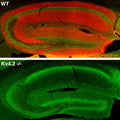
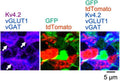
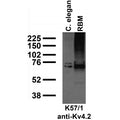
Immunofluorescence staining of adult wild-type (WT) and Kv4.2 knockout (Kv4.2-/-) mouse hippocampus with K57/1 (red) and Kv2.1 rabbit (green).
Kv4.2 K+ channel (Potassium voltage-gated channel subfamily D member 2 ) is a member of the mammalian Shal-related family and potassium voltage gated channel subunit family. Kv4 subunit family includes four Kv4 α subunits (Kv4.1, Kv4.2 and Kv4.3). However only Kv4.2 and Kv4.3 are predominantely expressed in the brain (Alfaro-Ruiz et al., 2019). Kv4.2 K+ is encoded by gene KCND2 in human. It helps to regulate the action potential's circadian rhythm firing in suprachiasmatic nucleus neurons. This process regulates the circadian rhythm of locomotor activity. It has been demonstrated that Kv 4.2 and Kv4.3 are often colocalized with pain-modulating molecules in rat spinal lamina II excitatory interneurons (Huang et al., 2005).
Purified by Protein A chromatography
1 mg/mL
Monoclonal
K57/1
IgG1
ELISA, EM, ICC, IHC, IP, WB
Mouse
KCND2 KIAA1044
75-80 kDa
Synthetic peptide amino acids 209 –225 (extracellular S1-S2 loop) of human Kv4.2 (CGSSPGHIKELPSGERY; accession number Q63881)
Human
C. elegans, Human, Mouse, Rat
AB_2131945
Aliquot and store at ≤ -20°C for long term storage. For short term storage, store at 2-8°C. For maximum recovery of product, centrifuge the vial prior to removing the cap.
Liquid
Produced by in vitro bioreactor culture of hybridoma line followed by Protein A affinity chromatography. Purified mAbs are >90% specific antibody.
10 mM Tris, 50 mM Sodium Chloride, 0.065% Sodium Azide pH 7.4
WB: 1:1000
IHC: 1:250
ICC: 1:250
Unconjugated
No cross reactivity against rat Kv4.3
Each new lot of antibody is quality control tested by western blot on rat whole brain lysate and confirmed to stain the expected molecular weight band.
These antibodies are to be used as research laboratory reagents and are not for use as diagnostic or therapeutic reagents in humans.
United States
24 months from date of receipt
voltage-sensitive potassium channel; Potassium voltage-gated channel subfamily D member 2; KV4.2; Voltage-gated potassium channel subunit Kv4.2
Q9NZV8
UniProt Summary: Voltage-gated potassium channel that mediates transmembrane potassium transport in excitable membranes, primarily in the brain. Mediates the major part of the dendritic A-type current I(SA) in brain neurons. This current is activated at membrane potentials that are below the threshold for action potentials. It regulates neuronal excitability, prolongs the latency before the first spike in a series of action potentials, regulates the frequency of repetitive action potential firing, shortens the duration of action potentials and regulates the back-propagation of action potentials from the neuronal cell body to the dendrites. Contributes to the regulation of the circadian rhythm of action potential firing in suprachiasmatic nucleus neurons, which regulates the circadian rhythm of locomotor activity. Functions downstream of the metabotropic glutamate receptor GRM5 and plays a role in neuronal excitability and in nociception mediated by activation of GRM5. Mediates the transient outward current I(to) in rodent heart left ventricle apex cells, but not in human heart, where this current is mediated by another family member. Forms tetrameric potassium-selective channels through which potassium ions pass in accordance with their electrochemical gradient. The channel alternates between opened and closed conformations in response to the voltage difference across the membrane. Can form functional homotetrameric channels and heterotetrameric channels that contain variable proportions of KCND2 and KCND3; channel properties depend on the type of pore-forming alpha subunits that are part of the channel. In vivo, membranes probably contain a mixture of heteromeric potassium channel complexes. Interaction with specific isoforms of the regulatory subunits KCNIP1, KCNIP2, KCNIP3 or KCNIP4 strongly increases expression at the cell surface and thereby increases channel activity; it modulates the kinetics of channel activation and inactivation, shifts the threshold for channel activation to more negative voltage values, shifts the threshold for inactivation to less negative voltages and accelerates recovery after inactivation. Likewise, interaction with DPP6 or DPP10 promotes expression at the cell membrane and regulates both channel characteristics and activity. Upon depolarization, the channel goes from a resting closed state (C state) to an activated but non-conducting state (C* state), from there, the channel may either inactivate (I state) or open (O state).
3751
Shipped on ice packs
Bulk Order Anti-Kv4.2 K+ Channel Antibody
Related Products
Recently Viewed
Your research is our top priority
Highly-validated antibodies and reagents from our family of brands.


![Immunoblot against crude membranes from whole mouse (MBM) or rat (RBM) brain and from human cerebellum [HBM(Cb)], cerebral cortex [HBM(Cx)] or hippocampus [HBM(H)] and probed with K57/1 (left) or N52A/42 loading control (right) TC supe.](http://www.antibodiesinc.com/cdn/shop/files/73-016-k57-01-wb-3_120x120.jpg?v=1703010422)


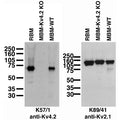
 KO Validated